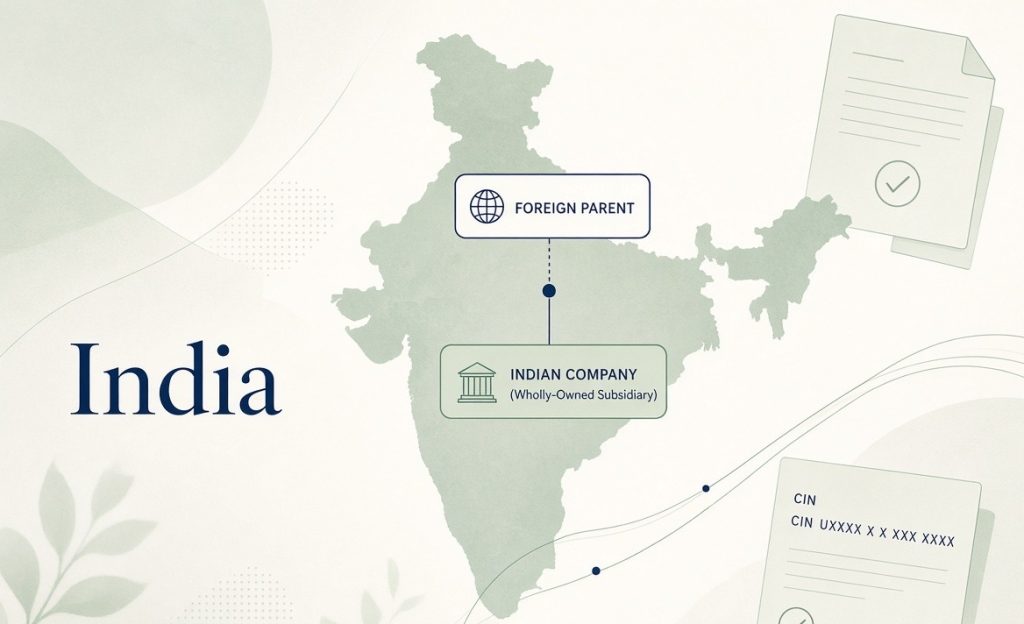
Private Limited Company in India for a Foreign National: Incorporate a Wholly-Owned Subsidiary Without Flying In
Updated September 2026 · Kaithal, Haryana
If you need a controlled Indian company that can invoice, hire, and hold contracts — and you do not want to fly in for paperwork — a wholly-owned subsidiary (WOS) structured as a private limited company is usually the route that fits. Here is how that decision actually works.
A liaison office cannot earn revenue. A branch office carries the foreign parent’s liability into India. A joint venture forces you to share control before you have tested the market. A private limited company owned by the foreign parent (a WOS) is a separate Indian legal entity under the Companies Act, 2013. In most sectors under the automatic FDI route, 100% foreign ownership is allowed without prior government approval. Confirm your sector against the current DPIIT Consolidated FDI Policy before you lock structure.
The incorporation itself is filed online through the MCA SPICe+ workflow. Foreign directors do not need to land in India for the filing. What they do need is apostilled (or consularised) identity and corporate papers, a Class 3 DSC, and at least one director who meets the Indian residency test. That is the real constraint — not a visa stamp.
Who this is NOT for
This piece is not for every overseas founder who has heard “register a company in India.” Skip this structure (or pause) if any of the following is true:
You only need a marketing presence or vendor coordination with no Indian billing. A liaison office or a pure contracting arrangement may be enough.
Your activity sits in a sector that needs government-route FDI approval, or carries foreign-investment caps. A WOS assumption fails before SPICe+ is filed. Confirm sectoral conditions against the current FDI policy.
Investment from a country that shares a land border with India is a separate approval track (Press Note 3 and later amendments). Do not treat that as a normal automatic-route WOS. Confirm the beneficial-owner map before SPICe+.
A foreign citizen cannot incorporate an OPC. Only an Indian citizen can be the member (Rule 3 of the Companies (Incorporation) Rules, 2014, as amended in 2021).
You are unwilling to appoint a resident director who meets the Indian residency test in Section 149(3) of the Companies Act, 2013. Residency for this purpose is a Companies Act test, separate from FEMA “person resident in India.” Confirm the year-count against the current bare Act.
You need the entity only to park a trademark or to look local on a pitch deck, with no intention of capitalising the company or filing FEMA reports. That path creates more exposure than value.
If none of those apply, and you want control, limited liability, and the ability to hire and invoice in India, keep reading.
WOS vs JV vs LLP — one comparison table
| Wholly-owned subsidiary (Pvt Ltd) | Joint venture (Pvt Ltd with Indian partner) | LLP with foreign participation | |
|---|---|---|---|
| Ownership | Foreign parent holds 100% (nominee shareholder used to meet the two-subscriber rule) | Shared with an Indian partner under a shareholders’ agreement | Partners hold interest as per LLP agreement |
| Control | Parent keeps board and equity control, subject to resident-director rule | Control is negotiated; deadlock and exit clauses matter early | Managed by designated partners; different governance feel |
| Liability | Limited to the Indian company’s assets | Same, but partner dynamics add commercial risk | Limited liability for partners, subject to LLP Act rules |
| FDI / FEMA | FDI into a company; FC-GPR after allotment | Same company route, plus JV commercial terms | LLP FDI rules differ; not a drop-in substitute for a WOS. Confirm current FEMA treatment for LLPs in your sector against the current FDI policy |
| Best fit when | You want a captive Indian company without sharing equity | You need a local partner for market, licence, or capital | Professional / light-asset models where LLP is allowed and preferred |
| Wrong fit when | You only need a temporary project presence | You are not ready to share control | You assumed “LLP = simpler WOS” without checking FDI and banking reality |
There is no universal winner. The table is a decision filter, not a ranking.
What “without flying in” actually requires
You can complete incorporation without travelling to India. You cannot skip the Indian resident director, the Indian registered office address, or authenticated foreign documents.
Resident director. At least one director must meet the Indian residency test in Section 149(3) of the Companies Act, 2013 (182 days’ stay). Confirm whether your facts are tested on the financial year or the calendar year against the current bare Act — do not use a blog’s year-count.
Two directors and two subscribers. A private limited company needs a minimum of two directors and two subscribers to the memorandum. For a WOS, the foreign parent typically holds nearly all shares; a nominee holds a tiny stake so the two-subscriber rule is met. Document the nominee arrangement properly.
DSC for every signing director. Foreign nationals obtain a Class 3 DSC using passport and overseas address proof, usually notarised and apostilled. Without DSC, SPICe+ does not move.
Apostille / consularisation. Parent company incorporation certificate, board resolution authorising the Indian subsidiary, power of attorney for the Indian professional signing on the parent’s behalf, and foreign directors’ KYC papers must be authenticated in the home country. Hague Apostille Convention countries use apostille; others follow consularisation through the Indian mission. Confirm the exact authentication chain for the parent’s jurisdiction against the current practice for that country — this step is what usually sets the calendar, not MCA processing.
Registered office in India. A real Indian address with proof (and owner NOC where required) is mandatory at filing. Co-working / managed office arrangements are common at day one; treat them as temporary infrastructure, not a compliance loophole.
Process — from decision to CIN
- Confirm FDI route and objects. Map the proposed Indian activity to the Consolidated FDI Policy. Automatic route vs government route changes everything downstream. Confirm against the current FDI policy.
- Lock directors, subscribers, and capital. Identify the resident director, foreign director(s), nominee subscriber if needed, authorised capital, and paid-up commitment. There is no meaningful statutory minimum paid-up capital for a private limited company, but the capital should cover real setup costs. Confirm any sector-specific capital condition against the current FDI policy.
- Obtain DSCs. Parallel-track this with apostille work. Foreign DSC issuance depends on document quality; weak scans burn weeks.
- Authenticate foreign documents. Board resolution, parent COI, POA, director KYC — apostilled or consularised as applicable.
- Name reservation (SPICe+ Part A). Prefer a name that will clear MCA and trademark screening. If you want the parent’s brand in the Indian name, attach parent NOC / board authority. Confirm naming against current MCA practice if the brand is already used in India.
- SPICe+ Part B + linked forms. Incorporation, e-MOA, e-AOA, DIN allotment for first-time directors, PAN, TAN, and typically AGILE-PRO-S linked registrations (GST / EPFO / ESIC / professional tax / bank initiation as applicable). Confirm with your filing pack which linked registrations you actually need on day one versus later.
- Certificate of Incorporation. MCA issues the COI with the CIN. PAN and TAN usually follow in the same workflow. That is incorporation — not “fully operational.”
Documents checklist (typical WOS filing set)
Foreign / parent side (authenticated as required):
- Parent company’s certificate of incorporation / registration extract
- Parent board resolution approving Indian subsidiary, capital, and authorised signatory
- Power of attorney in favour of the Indian professional filing SPICe+
- Passport and overseas address proof of foreign directors / individual subscribers
- Parent NOC if the Indian company will use the parent’s name or brand
Indian side:
- Resident director’s PAN, address proof, and residency-supporting evidence as required for DSC / DIN
- Registered office proof (utility bill / tax receipt as accepted) and owner NOC if premises are not owned by the company
- Consent to act as director, subscriber sheets, and declarations in the SPICe+ pack
- MoA objects drafted to match actual activity (and FDI-permitted activity)
Banking / FEMA pack after CIN (not optional if foreign capital is coming in):
- COI, PAN, MoA, AoA, board resolution for account opening
- FIRC / inward remittance evidence and AD bank KYC report for the foreign remittance
- Valuation / pricing support where FDI pricing guidelines apply — confirm instrument-specific requirements with the AD bank
- Board resolution for allotment; FC-GPR working papers for FIRMS filing
Treat this as a working list, not a frozen statute. Document sets shift with parent jurisdiction and share structure. Confirm the pack against the current FDI policy and AD bank checklist before you courier originals.
First 90 days after CIN
CIN is the start of a compliance clock, not the finish line.
Days 0–15 — bank account and books. Open a current account with an AD Category-I bank. Deposit subscription money. Without money in the company account, commencement and FEMA reporting stall.
Days 0–30 — first auditor. The Board must appoint the first auditor within 30 days of incorporation under Section 139(6) of the Companies Act, 2013. If the Board misses that window, the members appoint the first auditor within 90 days at an EGM.
On capital receipt — allot within the FEMA window. After foreign subscription money lands, allot shares within the prescribed period (commonly discussed as 60 days from receipt, with refund consequences if missed). Confirm the exact FEMA timeline for your instrument with the AD bank before you schedule the board meeting.
Within 30 days of allotment — FC-GPR. Report the issue of shares to the non-resident investor on the RBI FIRMS portal (Single Master Form — FC-GPR), routed through the AD bank. Late filing attracts Late Submission Fee and, in worse cases, compounding. Confirm current LSF / compounding practice with the AD bank — do not treat blog timelines as a substitute for the FIRMS acknowledgement.
Within 180 days of incorporation — INC-20A. File the declaration of commencement of business after subscribers have paid in. The company should not commence business or borrow until this is done. The statutory outer limit is 180 days; for a capitalised WOS you normally want this far earlier, inside the first 90 days if the bank account and remittance are clean.
GST and employment registrations. Take GST when your supply profile requires it (including many export-of-services models where ITC / LUT matters). EPFO / ESIC follow headcount and coverage thresholds. Confirm triggers for your state and activity against current law.
Registered office and statutory records. Keep the registered office capable of receiving MCA and tax notices. Start statutory registers and minute books while the file is still clean — fixing them after the first scrutiny is more expensive than doing them once.
What “done” looks like at day 90. COI + PAN/TAN in hand, bank account live, capital in, shares allotted, FC-GPR filed or firmly in AD-bank review, INC-20A filed or scheduled with evidence ready, auditor appointed, and a written list of the next FEMA / ROC / tax calendars (including the annual FLA return for companies with foreign investment — due by 15 July each year). Confirm FLA applicability for your facts with the AD bank.
Common mistakes that look small and are not
Treating name approval as incorporation. It is only a reservation.
Assuming a foreign founder can be the sole director. Two directors minimum; one must be resident.
Skipping apostille quality control. MCA and DSC vendors reject weak notarisation chains constantly.
Bringing in capital and delaying allotment / FC-GPR. The remittance is not the compliance; the reporting is.
Using an LLP comparison copy-pasted from a domestic startup blog. Foreign-owned LLP and foreign-owned private limited company are different FEMA conversations.
Questions people ask before they commit
Can a foreign national incorporate a private limited company in India without visiting?
Yes, for the MCA filing workflow, if DSCs, authenticated documents, a resident director, and an Indian registered office are in place. Travel is not the statutory bottleneck. Document authentication and the resident director are.
Is a wholly-owned subsidiary the same as FDI under the automatic route?
A WOS is the corporate form. Automatic-route FDI is the investment permission for that form in eligible sectors. You can have the corporate form ready and still be blocked if the activity needs government approval. Confirm sectoral conditions against the current FDI policy first.
Do I need an Indian co-founder?
No, not for a WOS. You need a resident director and a second subscriber (often a nominee). That is not the same as giving away equity to a local co-founder. A JV is a separate commercial choice.
What is the difference between apostille and consularisation?
Apostille is the Hague Convention authentication used by member countries. Where apostille is not available, documents typically go through the Indian embassy / consulate chain (consularisation). Confirm the path for the parent company’s country before you draft the board resolution pack.
How long does incorporation take if we never fly in?
MCA processing after a clean SPICe+ upload is often measured in days. End-to-end time is usually driven by apostille / consularisation and bank account opening, not by the Registrar’s click. Plan the foreign paperwork first.
Can profits be sent back to the foreign parent?
Dividends can be repatriated after Indian corporate tax, subject to withholding tax and FEMA rules, with DTAA relief where a treaty applies. Confirm the treaty position for the parent’s country and the current withholding rate before you model cash returns.
What happens if FC-GPR is late?
It is a FEMA reporting default. Expect Late Submission Fee at minimum; older or larger defaults can require compounding. Get the FIRMS entity master and business user set up as soon as the AD bank account exists so the 30-day allotment clock is not wasted on portal registration.
Where this leaves you
If the decision in front of you is “controlled Indian company, foreign ownership, no flight for paperwork,” a private limited WOS is usually the structure worth modelling — after FDI sector checks, not before.
A 30-minute discussion is enough to test whether your activity sits on the automatic route, whether your resident-director plan is real, and what the document chain looks like from your home country.
Also read: Virtual CFO Services in India
WhatsApp: +91 96437 79939
Shubham Pahuja and Associates
https://shubhampahujaassociates.com/